
Perfume Bottle Sizes: Choosing Between 30ml, 50ml and 100ml
How common perfume bottle capacities map to discovery, mainstream and flagship product roles, and what each size changes in glass weight, filling, decoration and transit.
This guide explains market-level size logic for sourcing conversations. Exact capacities, brimful volumes, dimensions and availability for any Tengyao model are confirmed only in a model-specific written quotation.
Scope and source boundary
This article helps a buyer decide which capacity band to request before asking for quotations. It does not publish Tengyao model dimensions, because the verified archive supports style and finish evidence rather than a universal size chart. Treat every capacity discussed here as a market convention, then confirm the exact nominal and brimful volume of the quoted model in writing.
Capacity is never only a number. The same nominal volume can be realized in a tall slim cylinder, a flat rectangle or a heavy-base square, and each geometry changes glass weight, spray system choice, decoration area, carton size and transit risk. Choose the capacity band first, then the geometry, then the components.
1. What common perfume bottle sizes signal in the market
Across fine-fragrance retail, a few capacity bands repeat because they map to distinct commercial roles. Understanding those roles prevents the common mistake of requesting one bottle shape in every size, when the market actually expects different proportions at each band.
| Capacity band | Common market role | Typical buyer questions |
|---|---|---|
| 5ml to 15ml | Discovery sets, travel sprays, gift-with-purchase | Spray or roller format, refill behavior, pack-out count per set |
| 30ml | Entry full-size, online-first and niche lines | Bottle weight, label area, carton footprint, price laddering |
| 50ml | Mainstream retail standard in many markets | Shelf presence, sprayer output, cap proportion, gift boxing |
| 100ml | Flagship and value size for established lines | Glass distribution, base stability, transit protection, freight cost |
A new brand usually launches in one band, proves sell-through, then extends. Discovery bands recruit users; 30ml lowers the first-purchase barrier; 50ml anchors the line; 100ml rewards repeat buyers and improves margin per shipment.
2. How capacity changes glass weight, shelf presence and decoration area
Glass weight does not scale linearly with volume. A 100ml bottle needs thicker walls and a wider base to stay stable, so its glass weight often rises faster than its capacity. That weight affects freight cost per unit, the feel of the product in hand and the perceived positioning of the line.
Decoration area changes too. Hot stamping, screen printing and transfer labels all need a flat or gently curved zone of usable glass. On a small 30ml bottle, a deep shoulder or heavy ribbing can leave almost no printable band; on a 100ml format the same artwork has room to breathe. Review decoration artwork against the exact bottle profile, not against a scaled render.
- Ask for glass weight per model, not per capacity band.
- Check usable print and label height on the actual silhouette.
- Confirm base diameter and stability for tall 100ml designs.
- Remember that heavy bases photograph well but raise freight cost.
3. Size, spray system and filling line
The spray pump, collar and cap must be proportioned to the bottle. A pump output that feels refined on a 30ml bottle can feel weak on a 100ml flagship, and an oversized actuator can visually crush a small discovery format. Neck finish availability also varies by model, so the closure system should be confirmed per model rather than assumed from the capacity.
On the filling side, small discovery formats multiply unit counts and change changeover time, while large formats raise the cost of every filling error. If the same line must serve both 30ml and 100ml, confirm that the neck finish and pump platform can stay consistent across sizes; that decision is covered in detail in the crimp vs screw neck guide.
4. Transit, pack-out and cost behavior by size
Small bottles ship more units per carton but more cartons per liter of fragrance; large bottles ship fewer units and concentrate more value in each one, which raises the cost of breakage. Dividers, inserts and carton strength should be specified against the final assembled dimensions and weight, not the bottle alone.
- Discovery formats: confirm set packaging and count-per-carton early.
- 30ml and 50ml: balance carton footprint against retail shelf depth.
- 100ml: specify drop-test expectations and divider construction in the RFQ.
Freight mode matters as well. Air freight punishes heavy glass quickly; sea freight rewards dense, well-protected pack-outs. State the intended shipping mode in the RFQ so pack-out proposals match the route.
5. A simple size-selection method for a new line
- Define the commercial role first: recruitment, entry full-size, mainstream anchor or flagship.
- Map the role to a capacity band using the table above, then sanity-check against the target retail price.
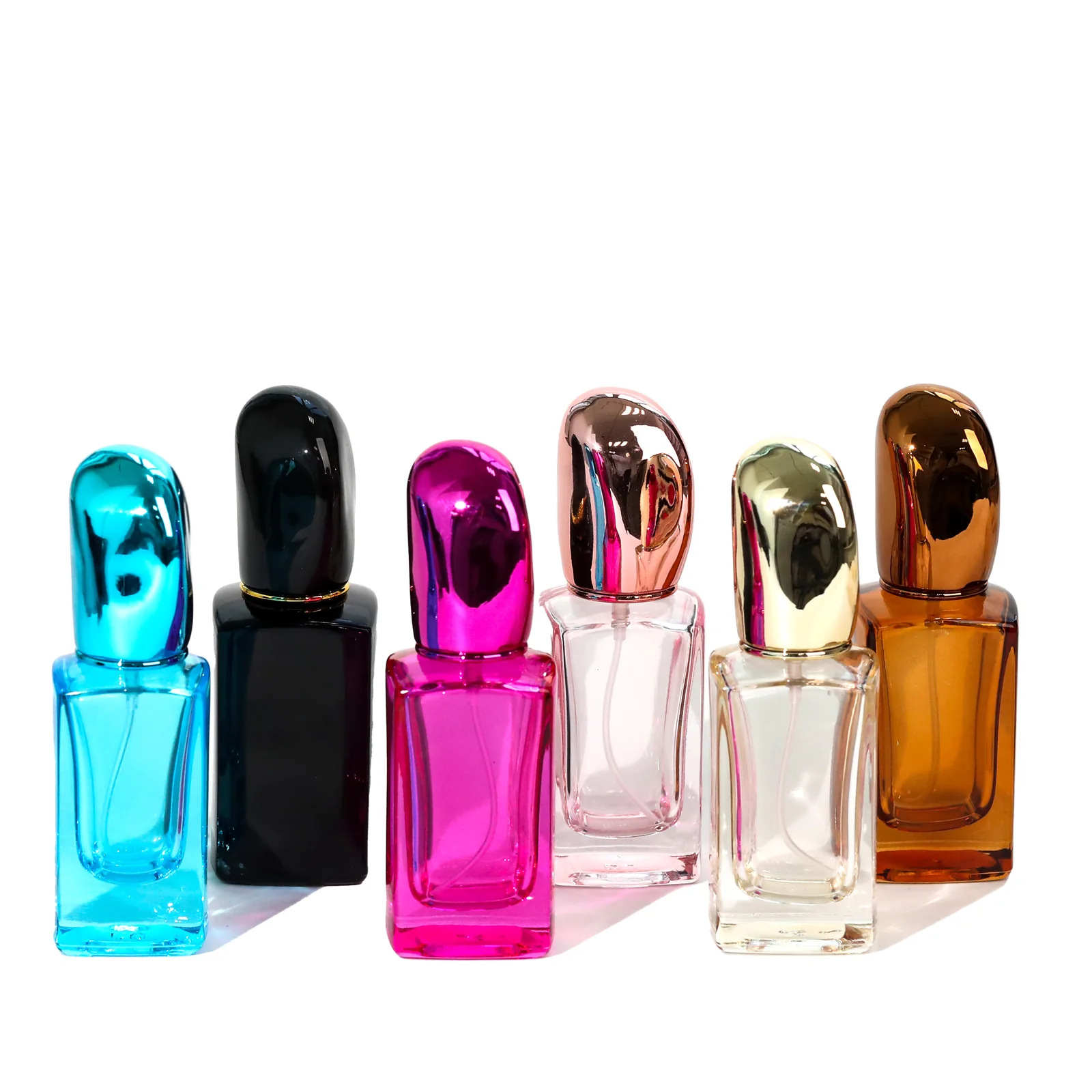
- Choose geometry within the band: the ribbed gradient perfume bottle suits tactile premium lines, while the square colored perfume bottle suits bold color-led shelf blocking.
- Lock the spray system and cap proportion for that exact model.
- Plan pack-out from the assembled dimensions, then price freight per unit.
If the line includes travel retail or refillable formats, compare the glass plan with aluminum perfume bottles, which are built around portable, refill-led use cases rather than shelf weight.
6. What to confirm in a Tengyao quotation
The public site shows style directions from the source archive, not a size catalog. For any model, including the styles in the glass perfume bottles category, request the following in writing before comparing prices:
- Nominal and brimful capacity of the exact model.
- Glass weight, base diameter and full assembled dimensions.
- Neck finish and the matched pump, collar and cap list.
- Usable decoration area and approved artwork positions.
- Carton construction, count per carton and pallet plan for your route.
With those five answers, capacity stops being a guess and becomes a documented line item that survives sampling, production and inspection.
Turn a size decision into a quotation-ready brief
Choose the capacity band, shortlist two or three bottle styles from the archive, then generate a structured RFQ brief that records capacity, components, decoration and transit requirements in one document.